
Olmsted County Court Docket Searches
Start an Olmsted County court docket search with Minnesota Court Records Online, or MCRO. It reaches every Minnesota District Court case statewide. Narrow it to Olmsted County when needed. Four search routes are offered: Name, Case Number, Citation Number, and Attorney. The exact case or citation number is the surest path. Once a result appears, check the details with care. Compare the case title, filing date, category, court location, and party role before trusting it as the right record.
The person-name form gives you three tools. Run an exact search, or add a wildcard after at least two characters. Sounds Like catches spelling variations too. Pick Person or Business. Choose the Olmsted location, and narrow the category if you know it. Behind every Case Details page sits the Register of Actions. That is the chronological court record of filings and settings. It will not show every underlying document remotely. A name match alone also does not prove the entry belongs to the person you mean.
- Open MCRO, accept its access terms, and use Case Number when the Olmsted identifier is known.
- For a name search, select Person or Business, choose Olmsted, and add a category or date filter only when needed.
- Open View Case Details and compare the title, venue, filed date, status, and party role.
- Read the Register of Actions, then use Document Search with the same number for an available public filing.
- Contact Court Administration for a certified copy, a restricted record question, or a file that is not available remotely.
Note: A pending criminal matter may stay hidden from defendant-name results until conviction. Use the case number, citation number, or attorney route, or visit the courthouse terminal.
Olmsted Court Docket Access Routes
MCRO is just one way in. Minnesota Public Access Courthouse terminals, known as MNPAC, sit in each district courthouse. They usually offer the most complete electronic public access. Olmsted Court Administration can also pull locally stored public paper records at the counter. Most counter requests are handled the same day. A file stored off site may take longer. Rule 4, Rule 8, and sealing orders still limit every public channel.
Copies can also be requested by mail. Use the statewide form or a letter identifying the case and the document you want. Parties may file through Minnesota eFile and eServe in their own cases. A nonparty may need an administrative court-file number from Court Administration. The court lists a fax number, but treat fax as an uncertain route for copies. Phone lines help with procedural routing, not certified proof.
Whatever route you choose, one thread ties them together. The Olmsted County district-court record, the Olmsted County calendar, and any Court Administration request should all point back to a single case number. That identifier keeps every access route aligned for a party, researcher, or courthouse visitor.
| Olmsted access route | Best use | Limit |
|---|---|---|
| MCRO | Public case, hearing, judgment, and document searching | Remote records exclude protected material |
| MNPAC terminal | Broader courthouse electronic access | Judicial access rules remain in force |
| Court Administration counter | Public files and certified copies | Off-site records may take longer |
| Mail or eFile/eServe | Documented request channels | Confirm payment and eligibility first |
Inside an Olmsted County Court Docket
Minnesota calls its docket-style activity record the Register of Actions. An Olmsted County Case Details page can hold a lot: case number, title, case type, date filed, court location, judicial officer, status, citation number, case flags, related cases, parties, events, hearings, financial information, upcoming hearings, and an Appear By date. The mix you see depends on case type and public-access status.
Read each entry with context. A calendar event is not proof it occurred. A case category is not an outcome. Financial fields can shift, and an Active Warrant flag can change, so confirm it through the court or the official law-enforcement route. The entry to study closely is the one recording a plea, judgment, dismissal, or sentence, because that is the actual order.
| Case number | The Olmsted court identifier linking notices, the calendar, MCRO, and document requests. |
|---|---|
| Parties | Names paired with their case role, such as plaintiff, defendant, petitioner, or respondent. |
| Events | Chronological Register of Actions entries for filings and proceedings. |
| Hearings | Public scheduling details, including time, officer, location, and type where available. |
| Financials | Court-record amounts, not a current collection statement. |
| Disposition | The recorded outcome or procedural resolution, read from the relevant event or order. |
Olmsted Court Docket Search Fields
A known Olmsted number is the safest bridge to the right record. It links a notice or citation straight to the Register of Actions. Case numbers show up on complaints, sentencing orders, payment plans, and court notices. A citation number is usually a 12-digit number. It sits near the top of a traffic or ordinance ticket. Carry that identifier into MCRO, Document Search, Hearing Search, Judgment Search, the daily calendar, or a Court Administration request. That skips the guesswork of a broad name match.
Name searches should start narrow. Where lawfully available and needed, Date Filed and date-of-birth controls can separate common names. MCRO's Court Locations control lets you pick Olmsted or search statewide. Then reconcile results by title, party role, date, and venue. Keep in mind that a person's residence is not the court location.
| MCRO field | Olmsted use | Reading caution |
|---|---|---|
| Person or Business | Selects the right name-search type | Business search matters in civil cases |
| Case category | Narrows Civil, Criminal, Family, or Probate or Mental Health | It does not state the result |
| Date Filed | Limits the Olmsted filing period | It is not an event or conviction date |
| Court Locations | Selects Olmsted or statewide searching | Venue should be confirmed in Case Details |
Note: Narrow searching cuts false matches. No search control replaces comparing the actual case fields.
Courts That Keep Dockets in Olmsted County
Olmsted County sits in Minnesota's Third Judicial District. Its District Court is the trial court of original jurisdiction. It handles civil, criminal, family, probate, juvenile, traffic, and conciliation matters. Those function as divisions of one unified local court record rather than separate county courts. Conciliation Court is Minnesota's small-claims process inside that structure. It generally handles claims of $20,000 or less under current law and its exceptions.
Appeals leave the Olmsted trial-court docket behind. Most state appeals head to the Minnesota Court of Appeals. The Minnesota Supreme Court sits above it. Federal cases run on a separate track entirely. The United States District Court for the District of Minnesota uses PACER instead of MCRO. So identify the court level and case type before an Olmsted search begins.
| Level | Olmsted record role | Primary route |
|---|---|---|
| Olmsted County District Court | Local trial records across the district-court divisions | MCRO, MNPAC, or Court Administration |
| Conciliation Court | Small-claims process within District Court | MCRO Civil category and Court Administration |
| Minnesota Court of Appeals | Separate state appellate docket | Appellate-court resources |
| District of Minnesota | Federal records | PACER and federal clerk materials |
Minnesota's Find Courts page lays out the judicial structure that places the Olmsted trial court below the state appellate courts. That hierarchy explains why an Olmsted trial search will not return every appeal.
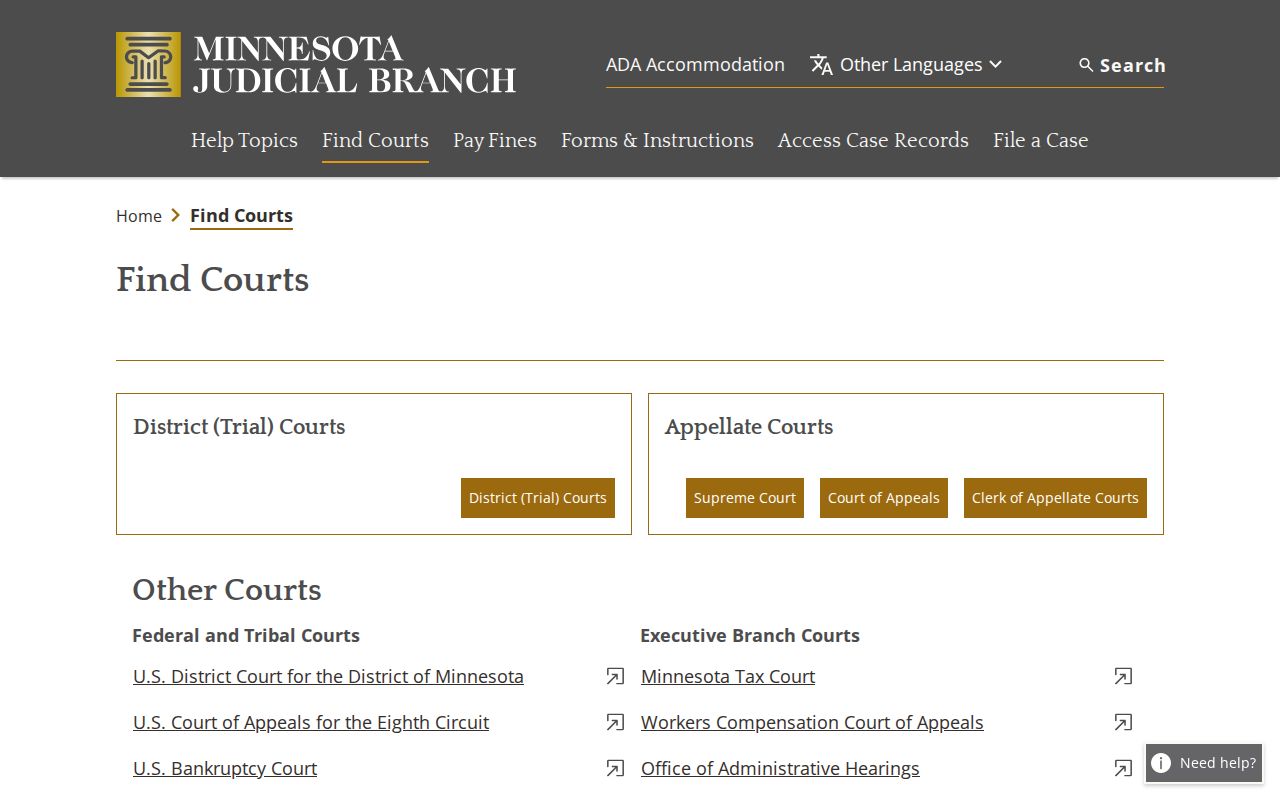
The same split keeps a federal case from being mistaken for a missing Olmsted court record.
Olmsted Court Docket Archive Gaps
Olmsted County's courthouse history explains part of the story. Old files can be hard to reach online. Court business started in a log schoolhouse and a hall on North Broadway. An 1867 courthouse followed, then a 1958 replacement, and now the Government Center. Courtrooms and Court Administration sit on the fifth and sixth floors there. Paper docket records from those earlier buildings do not always line up with what MCRO shows today.
The remote system makes many public civil and criminal documents available, within the access rules. These are documents filed after July 1, 2015. That does not mean an older Olmsted County court file vanished. It just means a different door. For an old case, try the courthouse terminal or the Court Administration counter. The law library and historical-record routing can help too. A digital Register of Actions and a historic paper file can take separate paths.
The Olmsted courthouse history page describes today's Government Center and the buildings that came before it.
That background helps whenever a record request stretches past what MCRO covers.
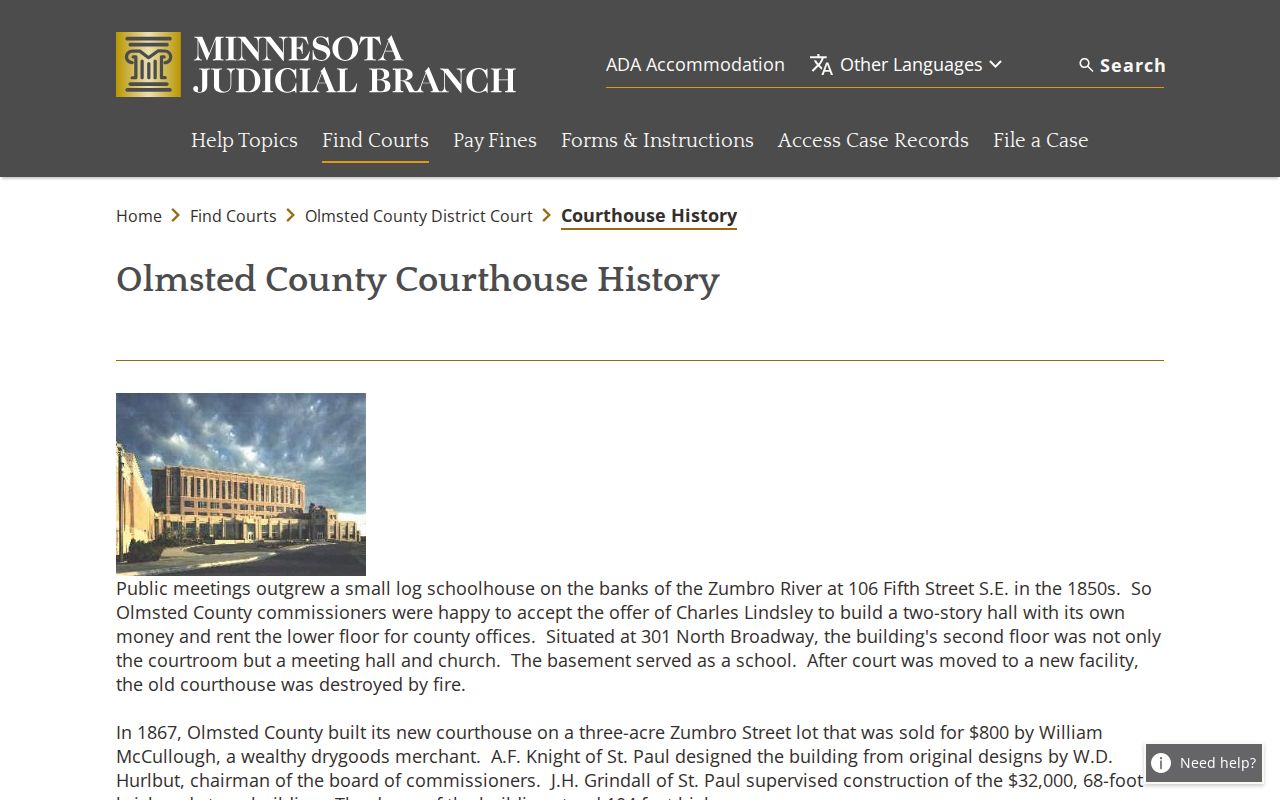
For older public court records, the current Olmsted courthouse is still the place to call or visit.
How to Find Court Dates and Settings
Start with MCRO Hearing Search. You can search an Olmsted County court docket by name, case number, judicial officer, or attorney. Then check the result against the official daily calendar and the Register of Actions. Hearing Search also allows an exact date or a date range, case-category filters, and an Olmsted location choice. The case number is your best tool. It ties a hearing line straight to the underlying court file.
For a time-sensitive setting, confirm directly. Criminal Scheduling answers at (507) 722-7326, Civil Scheduling at (507) 722-7325, and Court Administration at (507) 722-7264. Staff on those lines can route you to the right division. That helps even when the online information looks thin. The full local workflow is on the Olmsted County court dates page.
Olmsted Daily Court Docket Limits
The official Olmsted daily calendar is a planning aid, not a full court docket. The local court page posts the PDF at about 7:00 p.m. for the next day. It updates hourly from 7:00 a.m. Confidential and non-remotely accessible matters are left out. So a missing row for an Olmsted case means little by itself. It does not mean the hearing was canceled or reset. The printed calendars posted outside courtrooms and in public lobbies are described as the most current.
The Olmsted PDF lists party name, hearing location, date, time, judicial officer, hearing type, connection type, and case number. Courtrooms 5A, 5B, 5D, 6C, and 6D show up in its public rows. Labels like arraignment, review hearing, settlement conference, pre-trial, plea hearing, court trial, probate hearing, motion hearing, and administrative conference mark a stage of the case. None of them tells you the outcome. A hearing type is not a result.
- Arraignment
- An early criminal hearing concerning charges, rights, plea, and often release conditions, not a conviction.
- Connection Type
- A calendar descriptor for a party role or remote connection, such as Defendant, Petitioner, Attorney, or Zoom.
- Review Hearing
- A procedural review or compliance setting; the label does not state a final disposition.
Note: Before you travel or join remotely, open the live Olmsted PDF again and confirm the setting with the right division.
Public Access to Court Dockets
Every Olmsted court record answers to one framework. That framework is the Minnesota Rule of Public Access to Records of the Judicial Branch. Rule 8 lets the public inspect and copy the original case record during regular business hours, at its normal storage location, with exceptions. The rule defines the Register of Actions. It lists a case's title, origin, activities, proceedings, and filings. Remote access sits on top of that as a separate layer. A public Olmsted County case can therefore show less in MCRO. It may show more at the courthouse.
Rule 4 and Rule 8 also shield sensitive data. Remote public access may exclude or redact Social Security numbers, account numbers, protected street addresses, telephone numbers, juvenile details, and confidential records. Domestic-abuse, harassment, child-protection, delinquency, civil-commitment, and sealed matters carry special limits. A docket search can come up empty for many reasons. The cause could be any of those, an older document, a pending criminal indexing rule, the wrong venue, or a mistyped identifier. It does not mean the person has no legal history.
Olmsted access rules:
Rule 8 permits public inspection and identifies the Register of Actions while setting distinct remote-access limits.
Rule 4 identifies nonpublic and specially protected court records, including sealed and sensitive matters.
Minn. Stat. § 13.90 directs judicial-data access to Supreme Court rules instead of ordinary Chapter 13 treatment.
Olmsted Court Docket Copy Choices
A free MCRO download may be all you need for an available public document. It carries no certification. For an official Olmsted copy, go to Court Administration. It certifies a record once you supply the case number, the document title and date, and the certification level you want. Most local requests finish the same day; an off-site file can take longer. A mail request should use a form or letter and include payment rather than cash.
The statewide District Court fee schedule lists $14 for a certified civil or criminal instrument. Exemplified plus certified costs $28. Exemplified plus uncertified costs $14. Plain printouts, scans, and screen prints cost $0. A certified judgment search runs $5 per name. The fee page offers County, Category, and Search Court Fees controls. Confirm the added Olmsted law-library fee with the clerk before you send a request.
| Olmsted record request | Purpose | Observed statewide amount |
|---|---|---|
| MCRO public document | Available non-certified copy | $0 |
| Certified instrument | Official civil or criminal copy | $14 per document |
| Exemplified plus certified | Higher authentication request | $28 |
| Certified judgment search | Name-based judgment result | $5 per name |
Docket Records at the Clerk's Office
Olmsted County Court Administration serves as the local clerk function. It works within the unified Minnesota District Court record. It keeps the court file and provides access across civil, criminal, family, probate, juvenile, traffic, and conciliation divisions. One system covers them all. The catch is that an Olmsted caller may still need a different division phone line. The court-record system itself stays the same.
Olmsted Court Administration
151 Fourth Street SE
Rochester, MN 55904
(507) 722-7264
Official division contacts
Olmsted division routing
Civil: (507) 722-7281
Criminal/Juvenile: (507) 722-7279
Family: (507) 722-7333
Probate Registrar: (507) 722-7277
Start with the official Olmsted court page when you plan a visit. It carries current hours, jurisdiction, visitor instructions, and directions to the courthouse. That last part matters. The Government Center houses several county agencies. Knowing the court-specific route saves time once you arrive.
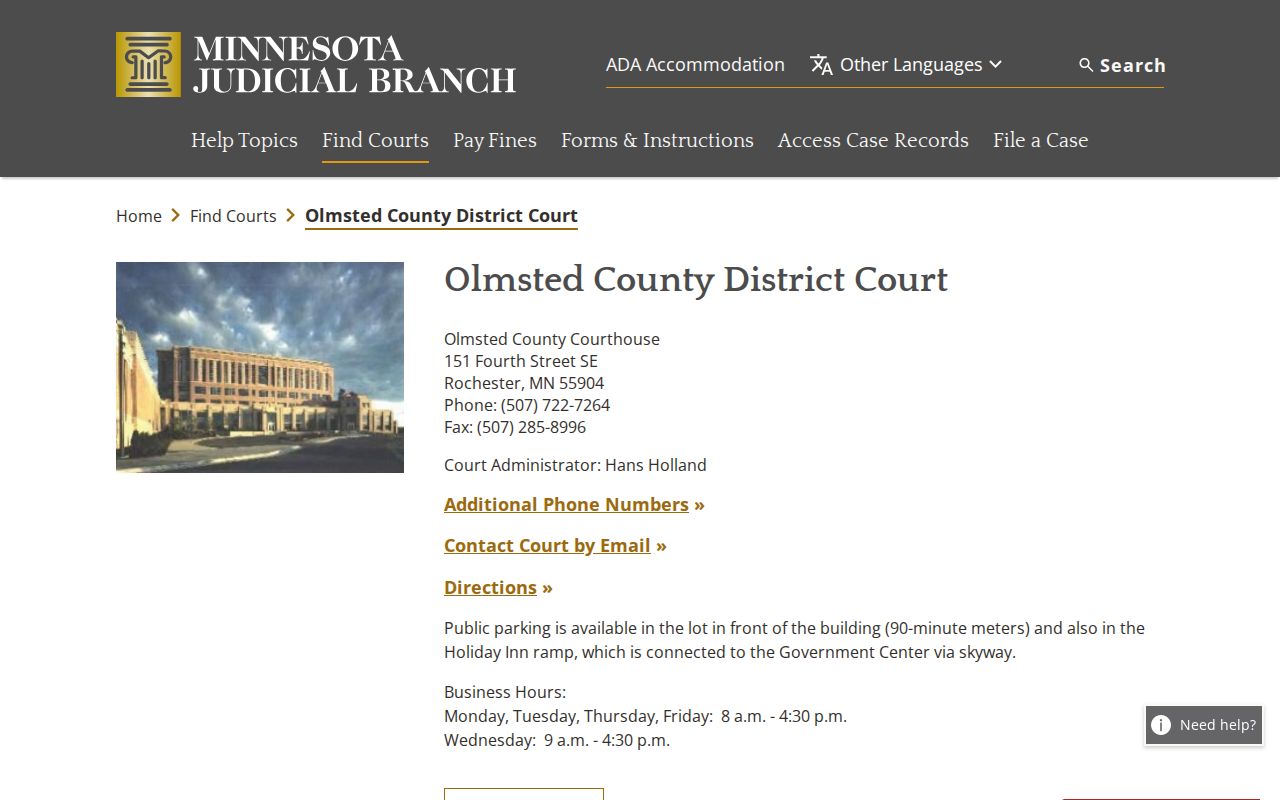
For an Olmsted Register of Actions or a certified court copy, go to Court Administration. A county agency counter will not handle that request.
Olmsted Court Dockets Beyond MCRO
A few Olmsted programs carry their own names and recordkeeping habits. None of them adds a second county trial docket. Consider the Olmsted County Treatment Court. It is a voluntary post-sentence program built on a minimum 15-month, five-phase structure, and the statewide directory lists it as a Drug/Driving While Intoxicated hybrid court. Veterans have a separate option too. The Third Judicial District Veterans Treatment Court takes in Olmsted cases. Both programs involve appearances and supervision, yet neither offers its own public search portal.
Diversion works differently from a normal case outcome. The County Attorney calls it a fact-specific, prosecutor-controlled alternative meant to cut docket burden and recidivism. It does that through treatment, education, or community programs. Asking about diversion tells you nothing by itself. It does not show that charges were filed or that anyone finished a program. For a public case search, stick with the Olmsted District Court Register of Actions, the court calendar, and the records rules.
Note: A specialized program can shape how an Olmsted case gets scheduled, but it never creates a separate public database or replaces the court record.
Olmsted County Court Dockets by City
Olmsted County has five largest incorporated cities by the 2020 Census ranking. They are Rochester, Stewartville, Byron, Eyota, and Oronoco. None of them runs its own municipal trial court. Minnesota's Judicial Branch has no separate city tier, so a case that starts in any of these towns becomes a court matter searched through MCRO and the Olmsted District Court record system. City Hall can field local administrative or ordinance questions. It is not the place to expect a complete Register of Actions.
Rochester adds a wrinkle. The city keeps its own parking and prosecution information, so a Rochester ticket may pass through a municipal administrative route before it ever reaches a court. Stewartville, Byron, Eyota, and Oronoco offer no official municipal court docket portal of their own. That gap does not mean no record exists. It means you should run a county-scoped MCRO search, check the Olmsted daily calendar, or ask Court Administration.
Rochester Docket Search
2020 population 121,395. Rochester parking and prosecution routes can differ from the Olmsted court-record route.
Stewartville Docket Search
2020 population 6,687. Actual court records route through Olmsted District Court and MCRO.
Byron Docket Search
2020 population 6,312. City Hall is an administrative contact, not the court-record custodian.
Eyota Docket Search
2020 population 2,006. Use the Olmsted court route for a case or citation record.
Oronoco Docket Search
2020 population 1,802. Retain the citation number, then use the Olmsted court route.
Rochester's contact page keeps the City Attorney and City Clerk clearly apart from Olmsted Court Administration. That distinction matters. Treat a Rochester administrative ticket as an Olmsted court case only once it actually reaches the court.
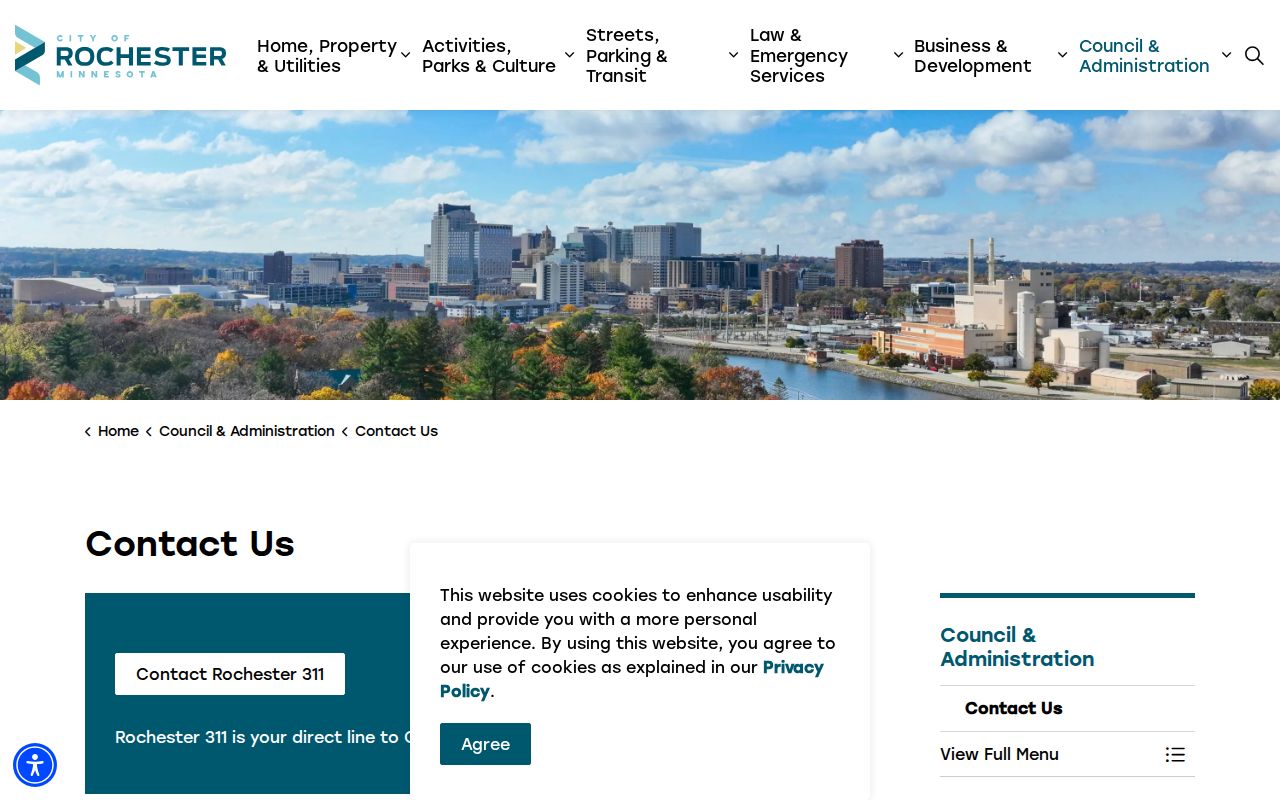
City contact numbers help with Rochester routing. Court Administration holds the actual Olmsted court record. The same split applies up the road. Stewartville City Hall serves as a local administrative contact, and no separate court portal exists for that Olmsted city. When a Stewartville matter turns into a court case, it lives in the Olmsted District Court record system.
The city source helps you reach the right local office. It is not a standalone Stewartville Register of Actions. Byron's official city page supplies the municipal contact. Use it for local ordinance questions. Any real court record from Byron still comes through Olmsted MCRO and Court Administration.
That division keeps the Byron city contact from being confused with the court records office. Eyota City Hall posts administrative information for Eyota residents. Court records, calendar entries, and certified copies from Eyota belong to the Olmsted court channels.
Keeping city administration separate from court record access prevents a false local-portal assumption. Oronoco City Hall is the right starting point for city questions. Follow an Oronoco citation or case through MCRO, the daily calendar, and Olmsted Court Administration.
Oronoco’s city contact does not replace the unified Olmsted court record system.
Olmsted Court Docket Work Context
Do not read one county-agency figure as a measure of Olmsted court docket volume. The math does not work that way. The Third Judicial District spans 11 counties. Its 2019 annual report counted 61,382 filings district-wide, not Olmsted-only. Olmsted County's 2024 budget message does note that population growth and increased court filings made justice space a priority. Useful context, certainly. It is still not a count for any single Olmsted court docket category.
For current court statistics, the Judicial Branch filing dashboard is the official route. Its live data gives real filing totals. Rely on it rather than treating an Olmsted agency workload figure as a court filing count.
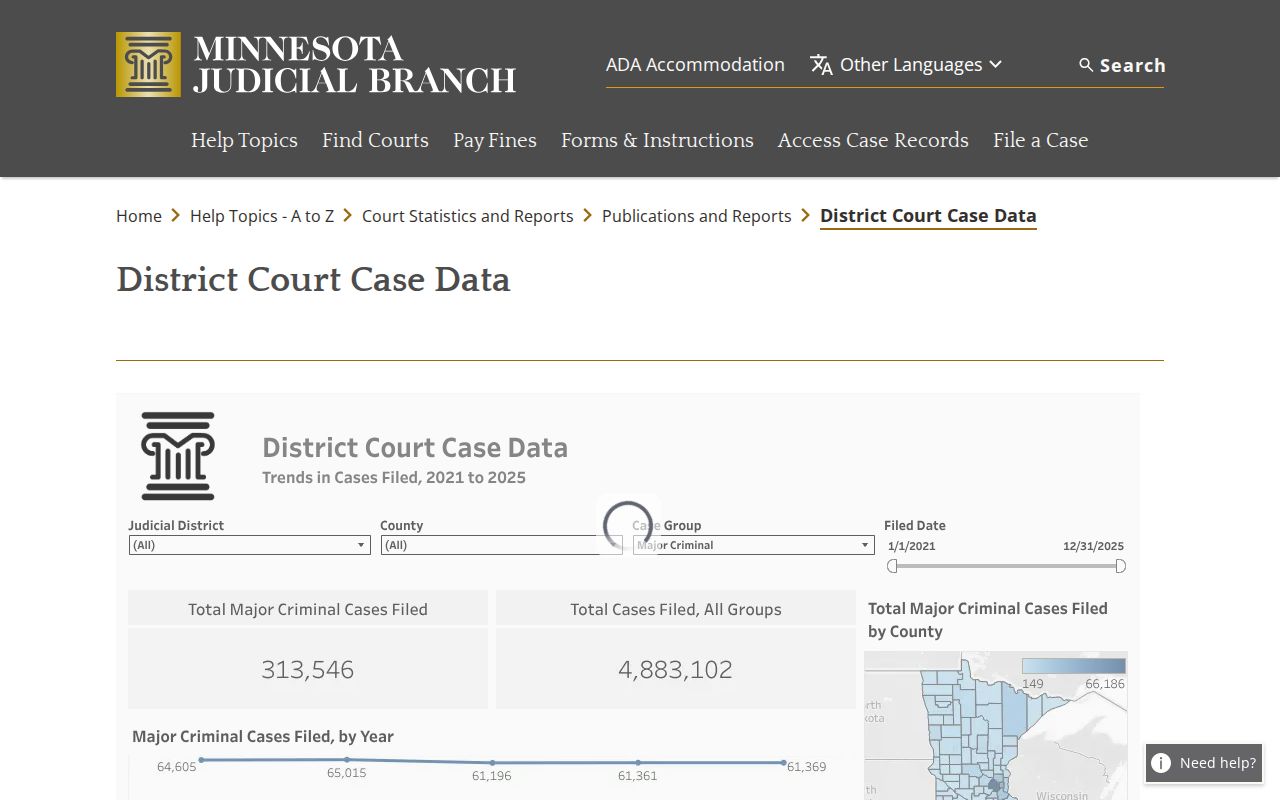
The dashboard keeps statewide and county-level court statistics in their proper context. For a neighboring view, the Sheriff's 2024 annual report offers Olmsted justice-system figures. Those numbers reflect court-related activity, but they cannot stand in for the court's Register of Actions.
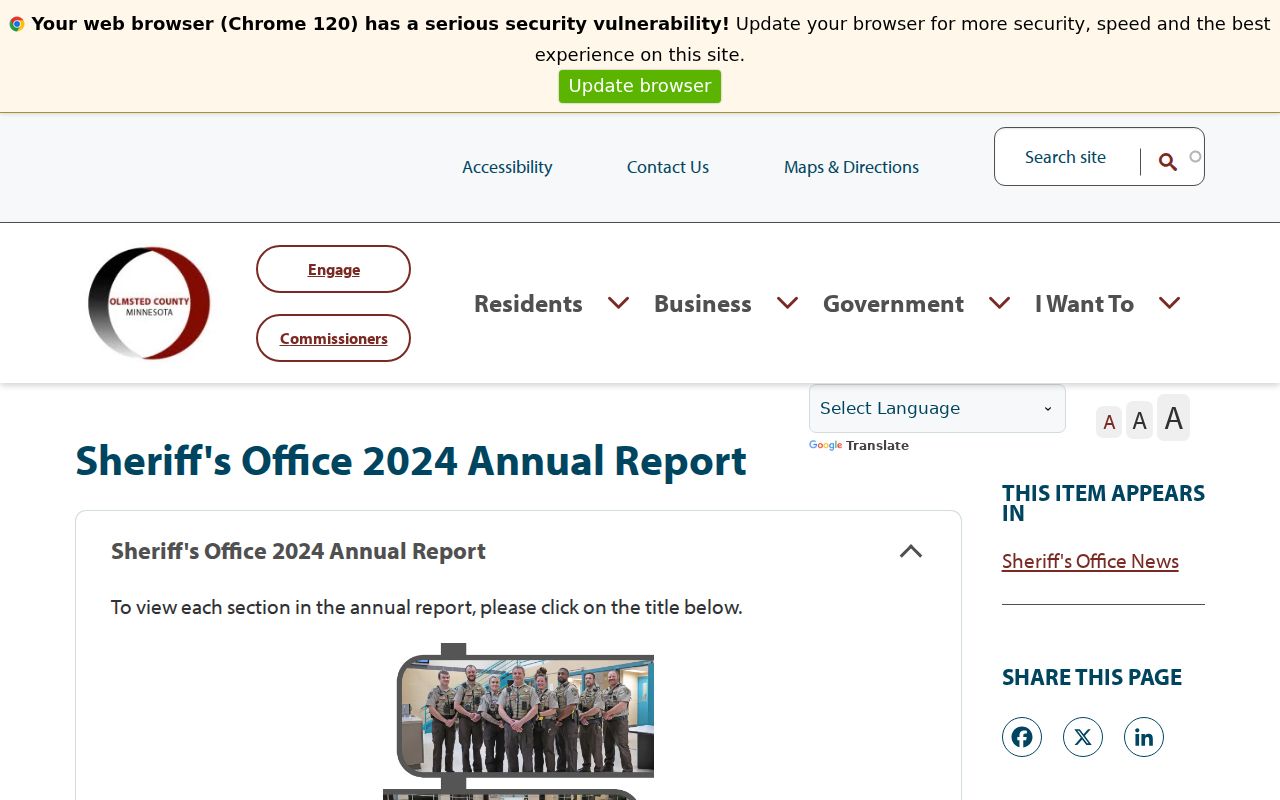
For a specific Olmsted case, the court record remains the source that matters.
Map and Directions to the Olmsted County Government Center
Olmsted County Court Administration keeps the District Court's civil, criminal, family, probate, juvenile, and traffic files at the Olmsted County Government Center, 151 Fourth Street SE in Rochester. Courtrooms and court administration sit on the fifth and sixth floors of the complex, which also houses the County Attorney, Community Corrections, Sheriff, Adult Detention Center, and other county agencies, so a visitor should follow court-specific floor directions rather than assume every ground-floor counter is a court window.
Olmsted County Government Center
151 Fourth Street SE
Rochester, MN 55904
(507) 722-7264
Monday, Tuesday, Thursday, Friday 8:00 a.m.-4:30 p.m.; Wednesday 9:00 a.m.-4:30 p.m.
Public parking is in the lot in front of the building, metered for 90 minutes, and the skyway-connected Holiday Inn ramp is another option. The court page warns that its online calendar omits confidential and non-remotely accessible matters and may not reflect a cancellation, so checking the printed calendar posted in the courthouse lobby is the more current source on arrival.