
Olmsted County Court Calendars Explained
Olmsted County District Court posts a daily calendar as a PDF. It drops at about 7:00 p.m. for the next Olmsted County court day. Updates then come hourly from 7:00 a.m. Think of it as a planning tool for the public. The Register of Actions stays the official record of case activity. No calendar line outranks a filed order, an attorney's advice, or the court's own instructions.
The court's own page is blunt about gaps. Confidential matters and cases that bar remote access never appear. So an Olmsted County case missing from the PDF is not automatically canceled or reset. Check before assuming anything. When a hearing is near, go to the printed calendars. They hang outside the courtrooms and in the public lobbies, and they are the most current version of all.
Olmsted County Daily Calendar Updates
Treat the Olmsted County daily calendar as a snapshot, not a promise. Pull a fresh copy before you head to the courthouse. A hearing may have been continued. It may have moved to remote access, or been set late the day before. An older file may not match any of that. The public URL carries no date-specific archive. A newer PDF can quietly replace the one you saved. A hearing already past? The Register of Actions and any public filing hold up better.
Note when you opened the file if a specific Olmsted County setting matters. A missing entry settles nothing. It does not reveal a confidential matter. It cannot tell you a hearing was moved. The current PDF, the case record, and the posted courtroom calendar are not rivals. Each one answers a different piece of the question. The official MCRO Hearing Search displays the Olmsted County party name, case number, judicial officer, attorney, and date filters. Use them for hearing research.
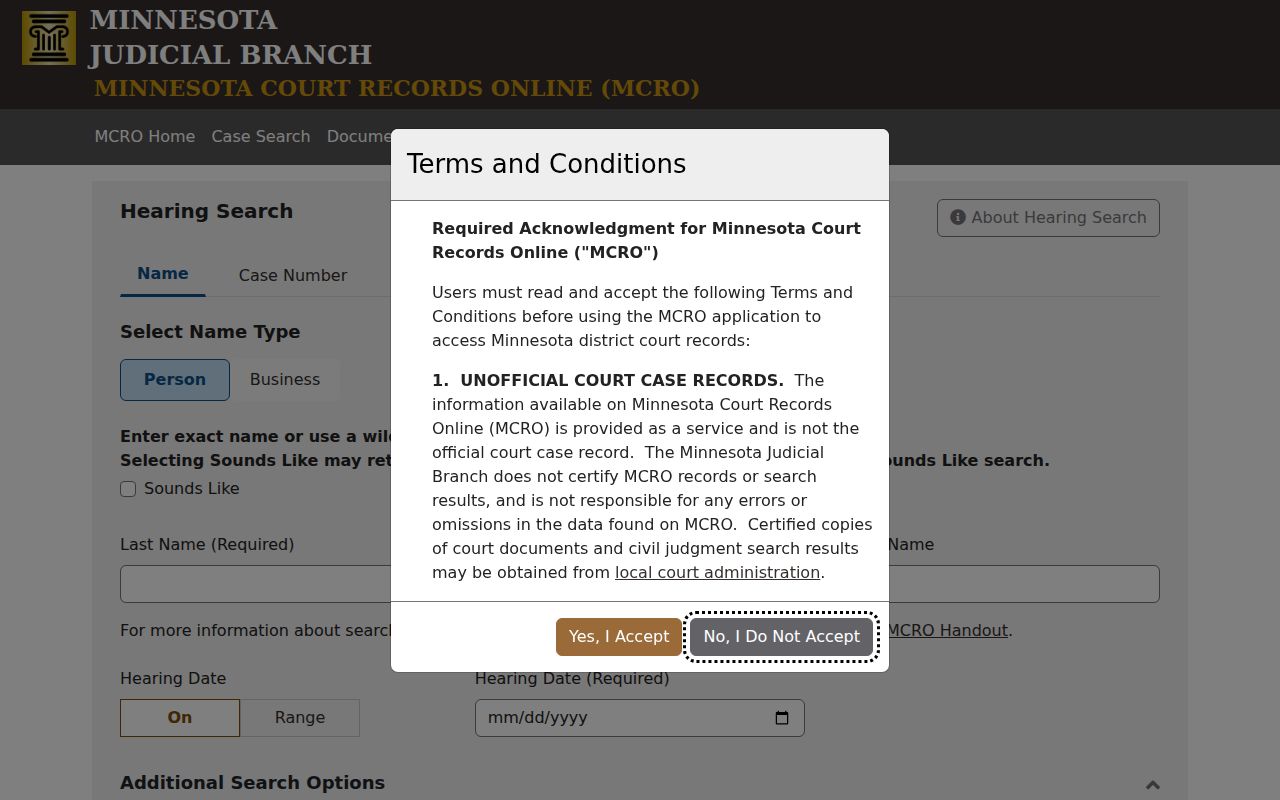
Run that Olmsted County search as a cross-check. Then go back to the current daily calendar and the case record when a time-sensitive setting needs firm confirmation.
Finding Your Court Date
A case number is the cleanest way into an Olmsted County court date. No case number? A party name works too, though a common one forces comparisons. Check the case type and the filing date. The venue and the party role matter too, so review them before trusting the match. You can also search the daily PDF for the case number or party label. From there, the MCRO Case Search opens Case Details. The Register of Actions there may list hearings. An Appear By date can appear as well.
- Open the current Olmsted County daily PDF and verify that its county and displayed hearing date are the ones needed.
- Search the Olmsted County PDF for the case number or party name. Record the time, hearing location, judicial officer, hearing type, and connection description.
- Open MCRO Case Search, select the Olmsted County location if needed, and use View Case Details to compare the hearing with the Register of Actions.
- For a current Olmsted County confirmation, check the printed calendar in the public lobby or outside the courtroom, then call Court Administration or the correct scheduling division. Criminal scheduling is (507) 722-7326 and civil scheduling is (507) 722-7325.
Each Olmsted County channel serves a different purpose. The PDF is fastest for a same-day setting. Hearing Search handles a name or case lookup, and Case Details adds context around the case itself. Court Administration can route a procedural question. A lawyer representing a party is one more source worth calling. Phone staff can explain where to go, but a call never replaces an order or a certified record.
Olmsted County Hearing Search Cross-Checks
Hearing Search gives you four ways in: Name, Case Number, Judicial Officer, and Attorney. The name tab goes further. It splits person from business. It also offers a Sounds Like option and filters for name parts, hearing dates, case category, and location. When a case looks local, pick Olmsted County from the location choices. Treat the results as a lead, though. The daily PDF and the Register of Actions are the pair that confirms a scheduled event. Olmsted County hearing results can change or run incomplete.
Case Details can turn a calendar case number into something richer. It shows parties, case type, status, indexed events, hearings, financial information, and flags. That is solid evidence of a public court record. A listed event may not keep its posted time. The entry also does not grant a remote attendee permission to join.
Work with an exact date or date range when you have one. An attorney or judicial-officer search can narrow a crowded Olmsted County docket fast. Even so, the court calendar still controls the public daily view. For a same-day question, look to print. The printed calendar in the lobby or courtroom is the court's stated most-current source.
A case number you already know also unlocks MCRO Document Search. It serves up public filings. Judgment Search does something different. It tracks debtors and judgment status, not court dates. Whatever either tool returns, pair it with the Register of Actions for real context.
How to Read a Court Setting
One row on an Olmsted County calendar carries a lot of information. The room, the time, and the judicial officer matter. Together they tell you where the setting should happen. The hearing type names the procedural event. Connection Type may show an Olmsted County party role or a remote descriptor. Read the full row with its case number. Then open MCRO before you trust any short label.
| Party Name | An Olmsted County displayed party label, which may be absent for protected matters. |
|---|---|
| Hearing Location | The Olmsted County courtroom or remote location. Visible examples include 5A, 5B, 5D, 6C, and 6D. |
| Date and Time | The scheduled Olmsted County event time. Confirm it again if the matter has changed. |
| Judicial Officer | The judge or referee assigned in the Olmsted County calendar row. |
| Hearing Type | The Olmsted County procedural label, such as arraignment, motion hearing, settlement conference, or court trial. |
| Connection Type | An Olmsted County party-role or connection descriptor. Zoom or DW-Zoom can appear with location information. |
| Case Number | The Olmsted County identifier to carry into MCRO for the related Register of Actions. |
Labels like "Arraignment," "Plea Hearing," and "Court Trial" describe Olmsted County stages, not results. A review hearing often deals with status or compliance. Commitment and harassment labels can also involve access limits. So do not use public search results to guess at private case details.
Olmsted County Court Calendar Labels
The Olmsted County calendar uses many hearing labels. That is because the District Court handles criminal, civil, probate, family, juvenile, and other matters. These plain terms keep each setting in context.
- Arraignment
- An early criminal proceeding concerning charges, rights, and a plea. It is not a conviction.
- Pre-trial
- A hearing before trial that may address readiness, motions, negotiation, or scheduling.
- Settlement Conference
- A court event intended to discuss resolving a civil matter. It is not a judgment.
- Motion Hearing
- A setting for a request that asks the court to make a ruling before or during a case.
- Administrative Conference
- A scheduling or case-management event rather than a ruling on the merits.
"Connection Type" is not an Olmsted County hearing label. It names a participant role such as defendant, petitioner, plaintiff, or attorney. It does not tell a reader how to enter a hearing.
Continuances, Resets, and Cancellations
A continuance or reset moves an Olmsted County hearing to another time. The update may show in the Register of Actions. Exact timing depends on court processing. It may also appear on the next daily calendar, and later on Hearing Search. The PDF refreshes hourly each morning. That makes it handy for Olmsted County same-day planning but not for tracking old settings. Reopen the current document rather than trusting a saved copy. When an Olmsted County hearing vanishes from the calendar, confirm the event. Do not assume the case ended. The gap may reflect a change, an omitted protected matter, or a formatting choice. For a future court date, call the scheduling line or Olmsted County Court Administration at (507) 722-7264. For a past event, check the Register of Actions. The public documents there carry the procedural record.
Olmsted County Court Date Connection Labels
Effective February 3, 2025, Minnesota changed its default hearing settings. In-person and remote defaults for Olmsted County cases now vary by case type. Judge-specific exceptions and approved deviations still stand. The Judicial Branch's hearing-setting announcement states the practical point plainly. Format depends on the Olmsted County case and current court instructions. A Zoom or DW-Zoom entry on the Olmsted County court calendar is an access clue, nothing more. It is not permission to join or record. An Olmsted County party should follow the notice, order, or direct instruction for that hearing. Public observers should use official court access information. They should honor any limits set for the event. The Judicial Branch also offers eCheck-In in most counties. Olmsted County parties need the name on the notice. A file number or date of birth works too. Checking in can happen before a hearing. It does not replace attendance or the required identification process.
If You Miss a Court Setting
Act fast if an Olmsted County court date was missed. Check the current Olmsted County calendar. MCRO Case Details holds the record of that setting too. Then call an Olmsted County lawyer if you have one. Or reach the division handling the case. Criminal and juvenile delinquency routing is (507) 722-7279. Civil routing is (507) 722-7281. The Olmsted County Court Administration contact page lists division numbers for other case types.
Missed a Setting? A missed Olmsted County court hearing can have serious case-specific consequences, including a new order or warrant-related action in some matters.
Confirm the current Olmsted County status with the court or a lawyer as soon as possible and follow any order or notice already issued.
Olmsted County Court Calendar Limits
Minnesota's public-access rules split Olmsted County public information from other material. That other material may be sealed, confidential, or unavailable remotely. The Rule 8 access rule treats Olmsted County registers and calendars as a remote-access layer. The Rule 4 access rule names categories that get special treatment. Olmsted County juvenile, child-protection, domestic-abuse, harassment, and mental-health matters may be limited or left out. An Olmsted County public record can go missing online. The courthouse's Minnesota Public Access Courthouse terminal can hold more than remote access does. The same protection rules still apply. For access questions, Olmsted County Court Administration and the counter are the right next stops. Calendar silence alone never proves a hearing was canceled. It does not show a case was not filed. It does not make an event open to the public.